


Your rights under the Victims’ Code
The Code of Practice for Victims of Crime (the Victims’ Code) sets out the service you can expect from the criminal justice system, from the moment you report a crime through to the trial in court.
Who is a victim under the Code?
The Code acknowledges that the terms ‘complainant’ and ‘survivor’ are often used in the criminal justice system to describe a person who has made a criminal allegation to the police. However, for the purpose of this Code, a ‘victim’ is defined as:
A person harmed by crime
a person who has suffered harm, including physical, mental or emotional harm or economic loss which was directly caused by a criminal offence.
A close relative
a close relative (or a nominated family spokesperson) of a person whose death was directly caused by a criminal offence.
You can also receive rights under this Code if you are:
- A parent or guardian of the victim, if the victim is under 18 years of age; or
- A nominated family spokesperson, if the victim has a mental impairment or has been so badly injured because of a criminal offence that they are unable to communicate or lack the capacity to do so.
Your rights under the Victims’ Code
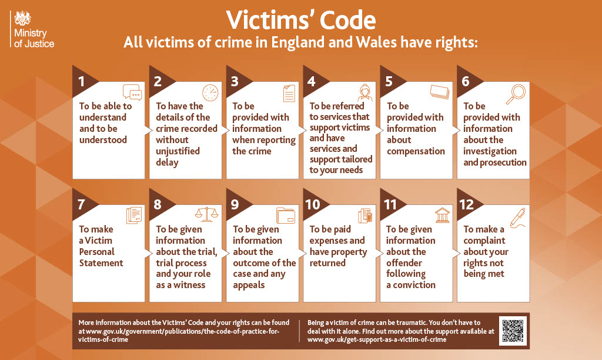
As a victim of crime, you are entitled to a minimum standard of service under the Victims’ Code. These rights are designed to ensure you are treated with fairness, dignity, respect, and sensitivity throughout the process.
Have the crime recorded promptly and accurately
Be informed about your case, including updates on investigations and decisions
Access support services that meet your needs
Understand the criminal justice process and what to expect at each stage
Make a Victim Personal Statement explaining how the crime has affected you
Be informed of the outcome of the case, including appeals
Receive information about the offender, where appropriate
Make a complaint if you feel your rights have not been met
Enhanced rights apply if you are considered vulnerable, intimidated, a victim of the most serious crime, or a persistently targeted victim.
Accessing your rights
As a victim of crime, you are entitled to access information about the range of victim support services available to you. You will be directed to victim support services where required under this Code, but this does not prevent you from accessing those services directly if you wish.
Service providers must communicate with you in simple and accessible language, taking appropriate measures (e.g. EasyRead, Braille or the use of a Registered Intermediary) to assist you to understand and be understood. In considering appropriate measures, service providers must take account of any relevant personal characteristic which may affect your ability to understand and be understood.
Learn more: