



TREES TOGETHER SOUTH YORKSHIRE
Trees shape the places where we live, work and spend time. Trees Together South Yorkshire is bringing local people, communities, landowners, researchers and decision-makers together to understand where trees are thriving, where they are needed most and how they can improve everyday life across our region.
The project is led by Professor Jill Edmondson and Dr Paul Brindley at the University of Sheffield, and Sara John at South Yorkshire Mayoral Combined Authority. It is managed by Catherine Nuttgens of Nuttgens Urban Forestry and funded by the Grantham Centre for Sustainable Futures.
Explore the Story Map and 3-30-300 interactive mapping to see what the evidence tells us about trees, green space and neighbourhoods across South Yorkshire.
What Trees Together is doing
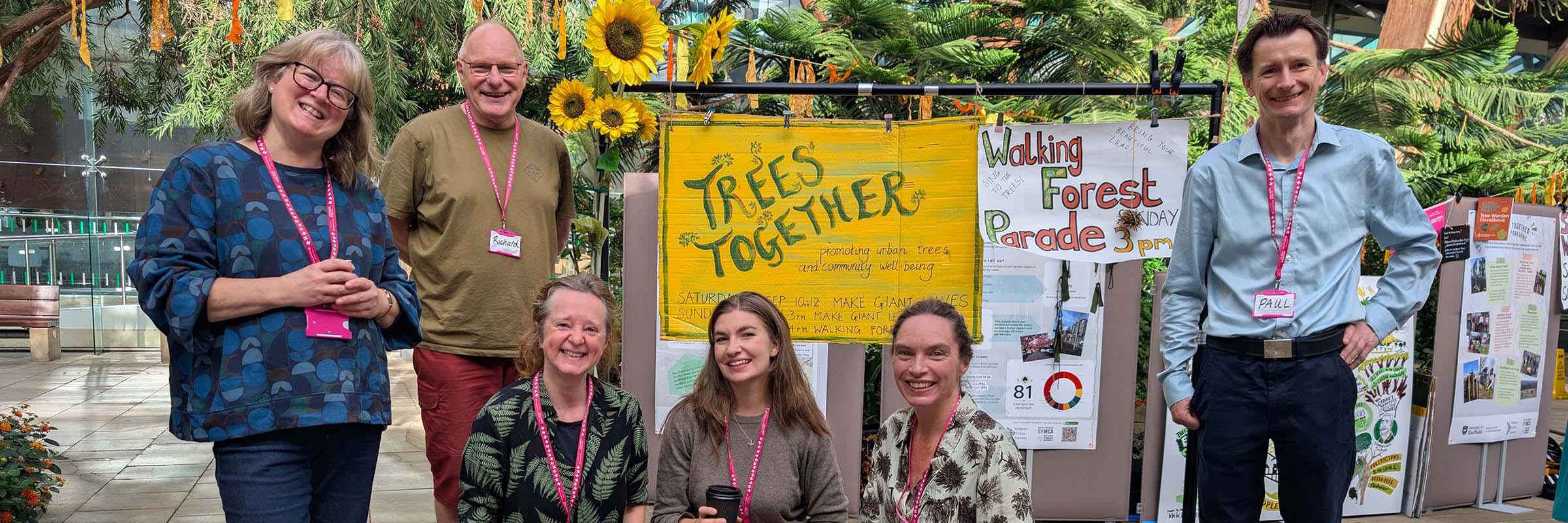
Trees Together combines local knowledge with research and mapping so that future decisions about trees are informed by the people and places they affect. The partnership includes the University of Sheffield, South Yorkshire Mayoral Combined Authority, Treeconomics and Nuttgens Urban Forestry.
Through the project, we have:
- Listened to people: held workshops and events in Barnsley, Doncaster, Rotherham and Sheffield to hear what residents and organisations value, where they see gaps and what would make a difference locally.
- Identified unequal access: mapped homes against the 3-30-300 rule to show where people have less access to visible trees, leafy neighbourhoods and good-quality green space.
- Shown what trees do for us: created a Story Map and economic assessment explaining the benefits provided by South Yorkshire’s trees and woodlands.
- Built stronger partnerships: brought together communities, landowners, practitioners, researchers and public bodies to share knowledge and resources.
- Shared local research: showcased the University of Sheffield’s Urban Tree Observatory and made evidence easier to use in decisions about neighbourhoods and investment.
The Story Map and interactive 3-30-300 map are now available below. Together, they show what South Yorkshire’s trees provide and where access to trees and green space is unequal.
Why trees matter to people
Trees are part of the everyday infrastructure of our streets and neighbourhoods. They can make routes to school, work and local services cooler and more pleasant, create welcoming places to meet and spend time, and connect people with nature close to home.
They provide shade during hot weather, help manage rainfall, store carbon, improve air quality and provide habitats for wildlife. Access to trees and green space can also support physical and mental wellbeing and help create attractive places where communities can thrive.
These benefits are not experienced equally. Trees Together is using evidence and local insight to show where access could be improved and to support fairer, better-informed investment across South Yorkshire.
What do our existing trees and woodlands provide?
South Yorkshire has around 4.5 trees for every resident. Trees Together used i-Tree Eco software to assess the structure, condition and value of the region’s trees and woodlands, helping us understand the benefits people receive now and what needs protecting for the future.
Five species make up just under half of all our trees: silver birch (23%), sycamore (7%), hawthorn (7%), ash (6%) and oak (5%). Understanding this mix helps those who care for the urban forest plan for a healthy and resilient tree population.
Does everyone have fair access to trees and green space?
The 3-30-300 rule is a widely used urban forestry guideline. It says that everyone should be able to see at least three mature trees from their home, live in a neighbourhood with at least 30% tree canopy cover, and be within 300 metres of a good-quality green space.
Working with Treeconomics, we mapped every household in South Yorkshire against these three measures. Only 4% of households meet all three, while a quarter meet none. Overall, 71% meet at least one measure.
The map helps make inequalities visible. It can support conversations with communities and help decision-makers focus future work where more trees or better access to green space could make the greatest difference.
What happens next?
The engagement events have now taken place. Thank you to everyone who shared their experience, knowledge and ideas about trees and green space across South Yorkshire.
The project manager is bringing together the outputs from the events and will prepare a short report setting out the findings and recommendations. This will connect what people told us with the evidence shown in the Story Map and 3-30-300 mapping.
The report and recommendations will be published here when they are ready. In the meantime, you can explore the Story Map and interactive map above.