


LET ZERO
What is Let Zero?
Let Zero is a One Stop Shop service to help Private Rented Sector (PRS) landlords and tenants improve thermal comfort, reduce fuel bills and tackle causes of damp and mould in rented homes across South Yorkshire. It started as an 18-month, 12-partner research project funded by Innovate UK. The service is now funded by SYMCA and open to all private landlords and tenants in South Yorkshire.
To access the Let Zero service, please visit the Let Zero website.
Research findings from the Innovate UK funded Let Zero project links to project reports and key recommendations can be accessed on the drop down sections below.
The final Let Zero project research report, produced by Ella Hubbard, Dawn Witherley, Will Eadson and colleagues from the Centre for Regional Economic and Social Research (CRESR), part of Sheffield Hallam University, is available here:
Let Zero: One-Stop Shop Governance and Delivery for the Private Rented Sector
We are also grateful for the research undertaken by Sylvia Moffat and colleagues from the South Yorkshire Sustainability Centre looking at Let Zero within the context of shaping PRS policy in South Yorkshire, and we feature excerpts from their partner interviews in the following sections.
Developing a One Stop Shop (OSS) for retrofit in the Private Rented Sector (PRS)
A programme of research on governance models for One Stop Shops (OSSs) was a significant output from the project. This research was carried out by the Centre for Regional Economic and Social Research (CRESR), part of Sheffield Hallam University, to inform the development of the Let Zero OSS. The report is available here: Lessons from existing retrofit one stop shops in the UK and Europe: business model and governance design
The research analysed 51 retrofit services across the UK and Europe and conducted 15 in‑depth interviews to understand real‑world OSS models, governance structures, customer engagement approaches, and implications for PRS retrofit.
Delivery Models
- Retrofit OSS services adopt three broad models: Facilitation, Coordination and All‑Inclusive. Most services avoid doing installations directly to maintain impartiality.
Value Proposition
- OSSs add value through impartial advice, quality assurance, simplified customer journeys and technical compliance. The complexity of retrofit is a significant hurdle to overcome.
Financial Sustainability
- Most services take 5+ years to reach sustainability. Successful OSSs diversify revenue through surveys, project management, technical compliance and grants.
Governance Structures
- Retrofit services use a mix of co‑operatives, Community Interest Companies, charities, private enterprises and local authority initiatives. Governance structures can influence liability, decision‑making and funding access.
Supply Chain Challenges
- Key barriers include shortages of accredited installers and high training costs. Effective OSSs support supply chain development through training offers and vetted supplier directories.
Customer Engagement and Service Design
- Retrofit journeys take years, so strong Customer Relationship Management (CRM) systems are essential.
- Landlords responded most strongly to trusted channels such as local authority badged newsletters, events with landlord representative organisations, such as the National Residential Landlords Association (NRLA), which suggests that a OSS must anchor itself in these networks.
- Tenants displayed fear of landlord reprisal and low confidence navigating retrofit—highlighting the need for neutral governance structures.
Implications for PRS Retrofit and Let Zero
The Private Rented Sector presents unique challenges: the “split incentive” where the benefit is provided to the tenant and the landlord bears the cost, a historic low level of landlord engagement with the need to make energy efficiency improvements, landlords wishing to use their own preferred contractors and trying to time work around void periods.
Developing from research outcomes into a successful One Stop Shop service
- Let Zero adopted the “Co-ordination” model – working collaboratively with other market players to support along the whole home improvement process while not doing direct installation work.
- The value proposition was initially set high by offering free retrofit assessments and whole house plans to landlords to drive engagement into the service and establish a market presence.
- Over the course of the project, the importance of understanding landlords’ and tenants’ concerns and needs heavily influenced the service design. This meant the development of distinct customer journeys for landlords and tenants, moving from detailed single property assessments into a lighter touch portfolio consultation which could help prioritise action across several properties (and in some cases consider disposal), and phased improvement plans.
- A sophisticated CRM with a front end that tracks customer interest through to completion and back-end tools to define the customer journey and provide advisors with prompts at the right stage in the process, creating multiple touchpoints and small tasks/positive updates for clients to build trust along the journey.
- The Let Zero OSS’s initial advice service, a free 20-minute chat with an advisor at a locally hosted “Energy Café”, is promoted across the region by local authority newsletters and other trusted advice networks.
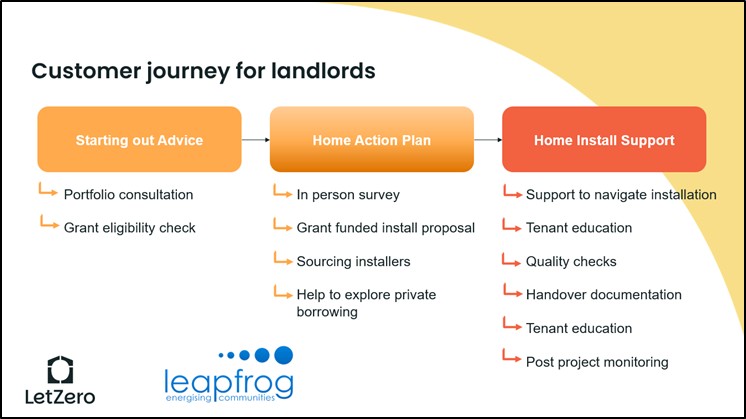
The Let Zero Customer Journey for Landlords
Development of digital tools to enhance the user journey
One feature of the Let Zero project was to trial the development of digital tools to enhance the customer journey and drive engagement. Planarific Ltd led work on creating a visualisation tool which could produce a 3D model of properties which were first drone surveyed, with machine learning to turn drone data into semantic models which could be rendered into recognisable features, with the aim of helping landlords and tenants to visualise potential retrofit measures.
A further aspect of the project led by Sustenic Ltd was to provide data-driven retrofit options scenarios for any given property in the region. This used EPC and other datasets with algorithms developed to provide cost and benefit predictions when applying a different combinations of retrofit measures - from single measures which might be sufficient to nudge a EPC “D” property into a “C” rating, to more substantial programmes with multiple measures, or a ‘whole-house’ approach.
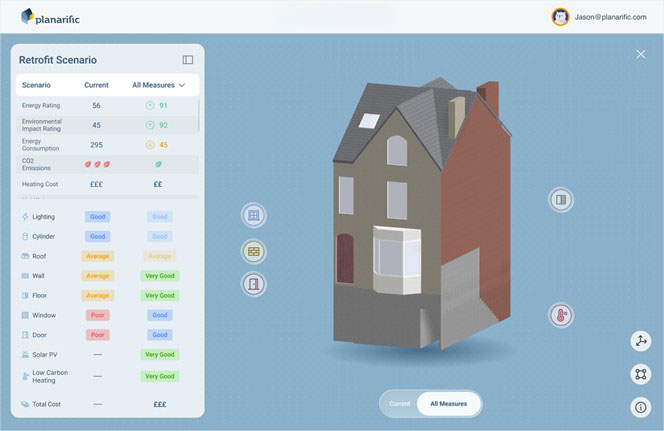
Retrofit visualisation and modelling of different retrofit options
Working with the retrofit supply chain
The Let Zero One Stop Shop service has been looking to find its place with the existing ecosystem of retrofit advice, coordination and installers in South Yorkshire. The ambition for the service to improve engagement with and open up a market of private rented landlords and tenants, creating a new pipeline of retrofit projects, made it important to talk to and understand the current retrofit supply chain.
Following an engagement event in April 2025, discussions between Let Zero partners and local supply chain companies, as well as research carried out by Energy Saving Trust on behalf of SYMCA, the following findings and recommended actions emerged:
- The region has around 130 TrustMark registered businesses carrying out retrofit measures, but with major gaps in insulation installer and PAS 2035 Coordinator capacity, plus a much larger “hidden market” of non‑registered SMEs. Let Zero has future potential to play a role in a central gateway for vetting, enrolling and supporting contractors, linked to:
- A shared South Yorkshire‑wide supplier vetting specification
- Back-end systems which can generate auto‑reminders for certificates/insurance renewals
- A transparent match between installer capability and funding streams
- Some key barriers for SMEs were highlighted when considering how they could take a greater role in retrofit delivery:
- onboarding/admin burden particularly for grant-funded measures
- lack of business support
- no clarity on retrofit demand
- limited awareness of PAS 2035 and MEES compliance related opportunities
- Let Zero could over time expand from a consumer facing service into a business facing development hub, offering:
- Signposting to business support, training, finance, and accreditation help
- An “associate installer” model with work fed to SMEs meeting agreed criteria
- Access to Let Zero’s digital tools (pre-assessments, landlord pipeline, whole house plans)
- Develop a regional retrofit strategy (led by SYMCA)
With insufficient skilled installers, too few retrofit coordinators, and unclear workforce pathways, a regional strategy would map:- the current supply chain (TrustMark, MCS, non registered SMEs)
- the required supply chain to meet Net Zero targets across the region
- gaps in skills (especially Insulation and PAS roles)
- training pathways across colleges, industry and private providers
- demand forecasts from Let Zero, Warm Homes Plan funded schemes and area-based pilots
- Creation of a South Yorkshire Retrofit Business Support & Networking Ecosystem
Research carried out by Energy Saving Trust stressed the importance of business incubation, networking and cross‑referral among SMEs, highlighting examples like Zero Carbon Harrogate’s Retrofit Professional Network. Key elements:- A regional Retrofit SME Network (virtual + in‑person)
- Regular “seeing is believing” project visits
- Outreach through builders’ merchants and trades collectives
- Targeted recruitment of non‑TrustMark SMEs to join the retrofit ecosystem
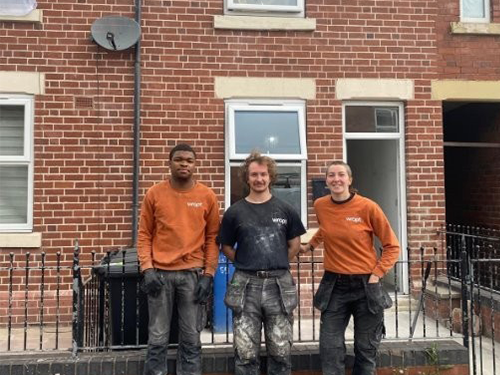
The retrofit installation team at the Let Zero show home
Working with landlords to improve energy efficiency
Landlord engagement by Let Zero aimed to determine the key barriers to retrofit and, where possible, reduce or remove these to encourage and promote retrofit measures within the Private Rented Sector (PRS). Partners took a comprehensive and diverse approach to working with stakeholders, including the PRS teams across Local Authorities, the National Residential Landlords Association (NRLA), letting agencies and sought insights into landlord financial behaviour patterns from mortgage brokers.
The main engagement tool was to run Energy Advice Cafes, offering landlords free energy assessments to begin their retrofit journey. A number of landlord meetings were also organised, including the first South Yorkshire regional landlord forum, led by SYMCA with support all its local authorities and the NRLA, with a total of 72 landlords and representatives from 16 local service providers in attendance.
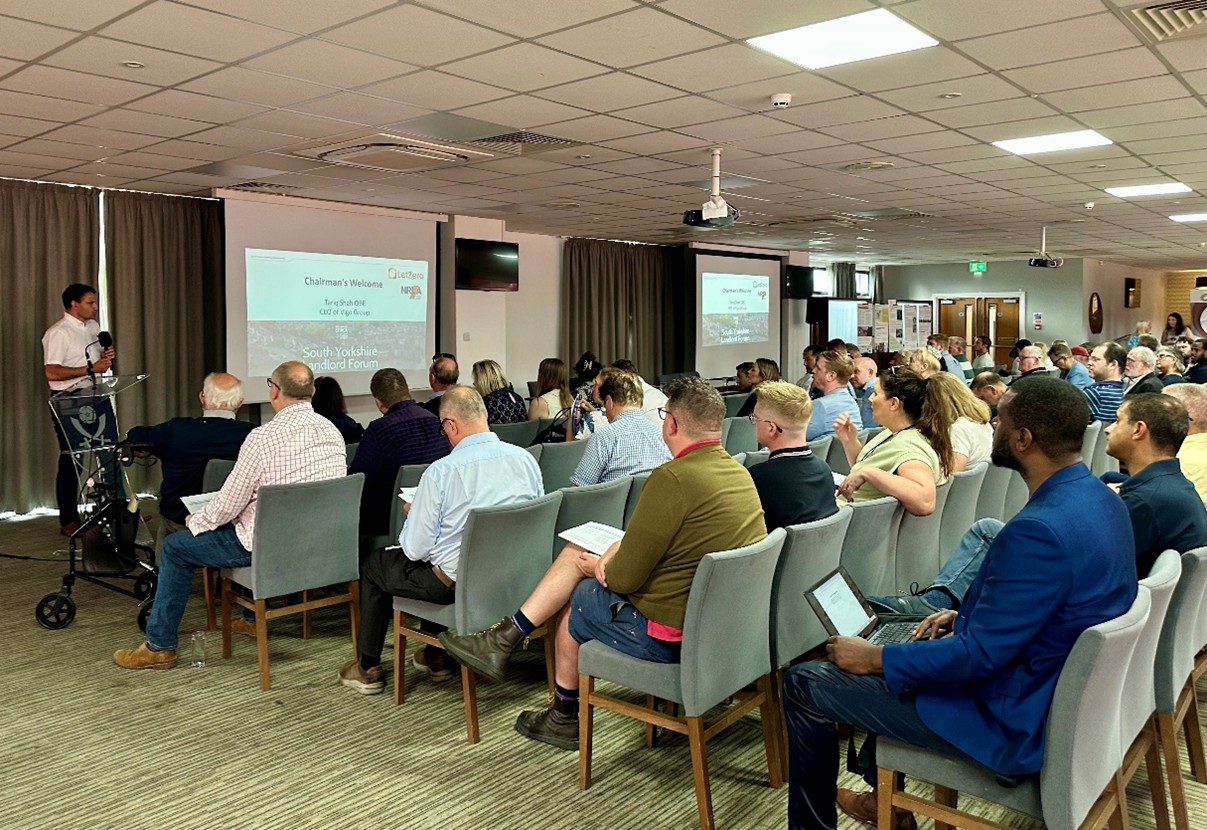
South Yorkshire Landlord Forum June 2025
Key findings from these activities:
- The main driver for undertaking retrofit improvements is regulation and compliance. The desire to comply with EPC “C” minimum standard and other requirements coming from forthcoming MEES regulations and the Renters Rights Act have been consistently cited as the chief motivating factor by landlords. It was unfortunate that the public consultation periods which delayed finalising MEES and EPC regulations through the lifetime of the project were seen to have a negative impact on landlords’ willingness to act.
- Landlords have shown a high level of interest in a service which can support them to access financial products and grant funding. Navigating complex bureaucratic processes and inaccessible forms is a barrier to many landlords, and simple help to fill in the forms and submit grant applications should be a key part of the OSS service offer.
- Landlords reported that quotes for grant funded work are often higher than those provided by local tradespeople on non-grant schemes. Some landlords have trade backgrounds and feel confident about doing the work themselves, or they have a network of trusted contractors whom they would use for all other work on their properties, so it is important for the service to support individual landlords to identify the best funding and delivery mechanism for their specific situation.
- Landlords are looking for a clear value proposition, as was the case with the initial offer of free retrofit assessments when the Let Zero service was first launched. When these ended, attendance at Energy Cafés dropped significantly. The development of a portfolio consultation offer, with early consideration of property EPC data prior to initial consultation, helped to re-engage landlords and enabled a more iterative, trust-building approach, offering value and insights broken down into manageable touchpoints along the customer journey.
- There is considerable scope and appetite for SYMCA or other organisations to offer further networking and learning opportunities to private landlords in South Yorkshire, and this will encourage more voluntary compliance with forthcoming changes to property EPC standards, and other changes introduced by the Renters Right Act.
“What [landlords are] really after is tools to help them make good business decisions about their housing stock,
about their portfolio of properties.”
“They're (landlords) kind of holding out for the legislation to change before they do anything.”
About the landlord forum: “It was almost like a business forum, right? It felt like that was really important to how we engage.
And there was clearly a desire for a network and more advice.”
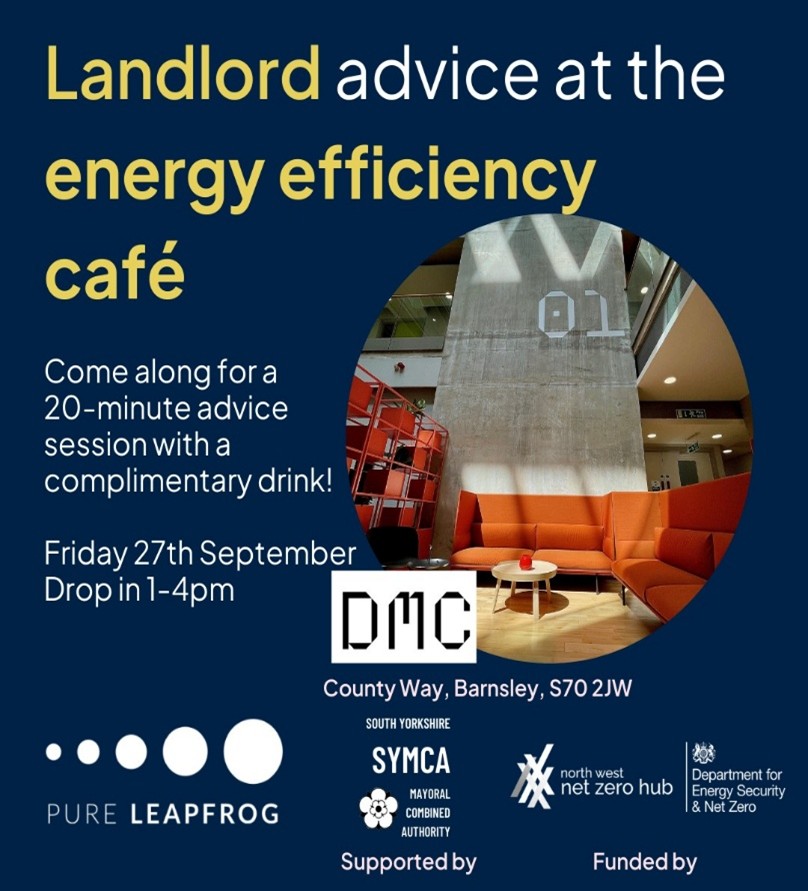
Landlord advice at energy efficiency cafe event banner in 2025
Informing and empowering tenants to seek property improvements
One major objective for the project was to address improvements to tenants’ living conditions and although gathering their views was a crucial part of the project, it also proved to be one of the most challenging areas. Some of the reasons for this are given below.
Our project partner, Centre for Energy Equality, undertook a Vulnerable Tenant Panel Session and the report from that session is included here: Vulnerable Tenant Panel Session Report (PDF 149kb)
In addition to this, interviews with private tenants from South Yorkshire were conducted by the research team at CRESR, Sheffield Hallam University. Further discussion and findings are published in the main project report:
Let Zero: One-Stop Shop Governance and Delivery for the Private Rented Sector
Main findings summarised:
- Interviewees reported common issues such as damp, mould, draughts and poorly fitting doors/windows.
- Barriers to improving energy performance included property-specific limitations and tenants’ lack of influence with landlords.
- Tenants were worried about needing to move out during works and who would cover relocation or temporary accommodation costs.
- Respondents said an OSS should offer guidance on tenancy rights and move out processes, and help broker discussions with landlords—potentially providing guarantees or support for disadvantaged tenants.
- Tenants recognised benefits such as improved comfort, longer stays and potential bill savings, but were concerned these could be offset by rent increases if retrofit works were carried out.
- There is a need for mediation services to support with landlord communication and advocate for tenant needs. A OSS can potentially meet part of this requirement but a partnership approach with other voluntary and community services might be needed to drive this forward.
"The project [...] really opened my eyes ... there's people living in accommodation which is not fit to live in and they're too scared to tell their landlord because of fear of eviction. So there needs [to be] education of what rights a tenant has"
Innovating on the installation of retrofit – the Let Zero “Show Home”
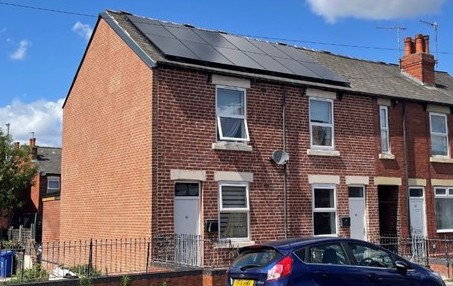
The Let Zero "Show Home"
Retrofit works can be lengthy and disruptive, leading many landlords to carry out only quick or cosmetic improvements between tenancies. To address this, Let Zero trialled products and processes designed for faster, lower cost installation.
Trials included a prefabricated external wall insulation system developed by partners Vundahaus Ltd, installed more quickly and at 10% lower cost than comparable systems, with a realistic brick slip effect to match the red brick finish common in properties across South Yorkshire. The long term goal is whole house installation within two days rather than the usual ten.
A prefabricated internal wall insulation kit developed by Wrapt Ltd was also tested, supported by the Advanced Manufacturing Research Centre (AMRC), part of the University of Sheffield, to refine installation processes, aiming to reduce installation to one day per room and adapted to real world challenges such as uneven Victorian walls.
The project also trialled a minimal disruption air source heat pump installation by ICAX Ltd.
Finding a suitable property proved difficult but a Victorian terraced home was eventually selected and a private landlord was recruited to host the demonstrator home.
A significant finding was that the tenants were more willing to tolerate disruption than is commonly assumed. This was reinforced by the strong relationship the project team built with the show home tenants, who were involved in decision making and supported throughout the process. Efforts were made to involve both the landlord and tenant in the design of the project, particularly when the replacement of a gas combi-boiler with a heat pump and water cylinder made it necessary to carry out some room reconfigurations. The tenant’s preferences during the redesign of bathroom and kitchen elements were taken into account in the final design.

Show home open day
The show home was a testbed for developing new processes and for helping to explain what common retrofit measures look like and how they work in a typical rented home. Landlords and local authority colleagues were invited to attend a series of show home open days over the summer of 2025 to see the transformation and understand more about the innovations for themselves.
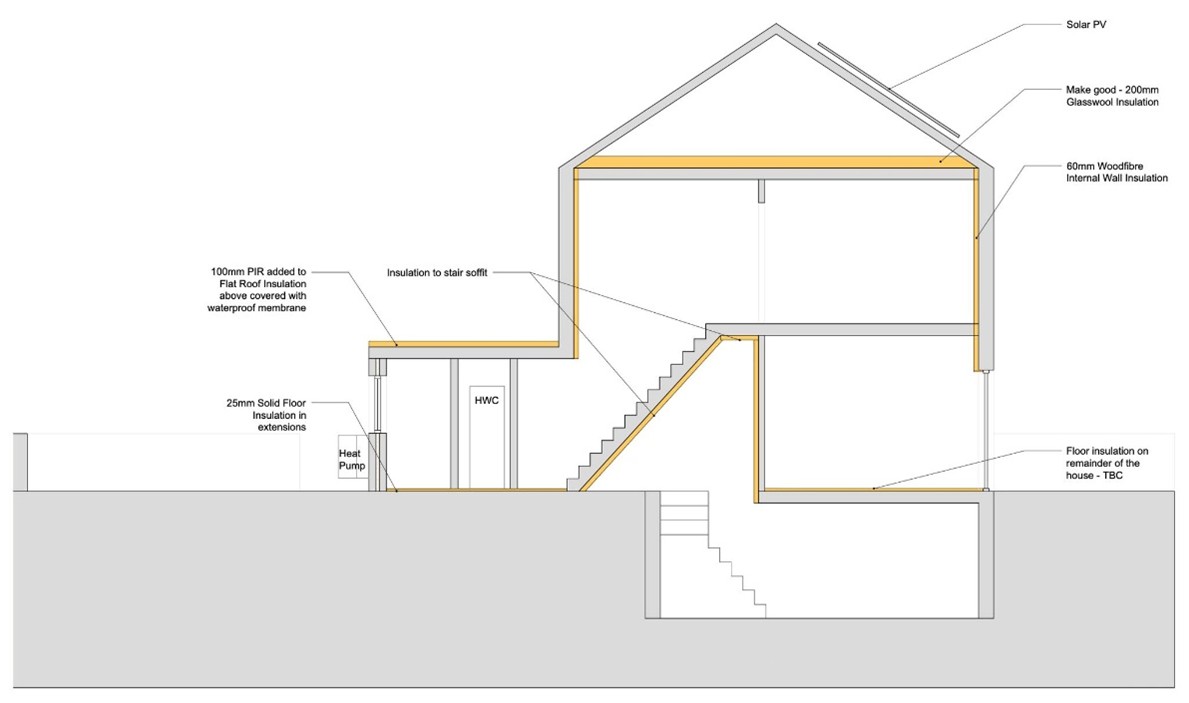
Design detail for show home retrofit measures
“With the team they (the tenants) were brilliant. They cooked them (project partners carrying out the works) dinner a lot of the evenings when they stayed later.”
“The way that (the product) was manufactured was not up to where we wanted it to be. So we're redesigning from scratch to avoid a lot of these problems we encountered. So unless you do those projects it [is] really hard [to] know.”
Learnings from the design, implementation and management of the Let Zero project
Let Zero has strengthened retrofit capacity and practitioner networks in South Yorkshire
- Let Zero has successfully increased the regional focus on retrofit across SYMCA and local authorities, while also helping to build a strong and growing network of retrofit practitioners. Partners have expanded their business capabilities, developed new expertise in the Private Rented Sector (PRS), and broadened their professional connections.
Early project partnerships were limited by rapid bid development and funding programme constraints
- The consortium of partners for Let Zero was formed quickly due to bid-writing timelines and funding terms and conditions. Partners recognised the value of the initial ‘innovation lab’ process which fostered cross-cutting partnerships between the partners. However this left less time to explore partner motivations, define roles, or understand different markets. As a result, collaboration potential was constrained and partnership development was less strategic than it could have been.
Governance of retrofit is evolving, creating an opportunity for SYMCA to lead a region‑wide service
- Local authorities have played a crucial role in the delivery of advice and retrofit measures, but are constrained by the limitations of separate siloed funding streams. However, with the expected devolution of retrofit funding to Mayoral Strategic Authorities, SYMCA is well positioned to provide strategic oversight, deliver more coordinated funding options and drive higher numbers of retrofit installations throughout the region - with services like Let Zero playing an important part in broadening the reach of retrofit into the PRS.
Upcoming legislation will increase pressures on the PRS but also strengthen Let Zero’s value proposition
- Forthcoming policy changes—including MEES, the Renters’ Rights Act, and EPC reforms—will raise compliance demands on local authorities and PRS landlords. While this creates operational challenges, it also offers opportunities for Let Zero to refine its service model, emphasising impartial, trusted support that can flex with evolving landlord and tenant needs.
Discussion and recommendations for policy makers and funders: retrofit in the Private Rented Sector (PRS)
Private rented homes perform worst across several English Housing Survey indicators, with the highest proportion of Category 1 hazards (10.2%) and non decent homes (21.1%). In Yorkshire and the Humber, 31% of private rented properties are classed as non decent — the highest of any UK region.
The poor energy performance and quality of the PRS is an issue of social equity at its heart. Tenants are often unable to exercise choice about where they live, with past studies showing as many as two thirds being ‘forced’ to rent privately because there are no other affordable options. Poor energy efficiency means in turn that higher proportions of private tenants suffer fuel poverty. Previous government grant schemes and financial assistance to improve the energy efficiency of private housing have failed to reach the PRS – the added complexity of negotiations with landlords, the mismatched costs and incentives are discussed more fully in the project’s research findings.
Let Zero was designed to address these challenges differently. Originating through addressing problems with the PRS faced by South Yorkshire’s Housing Directors at the Innovate UK Design innovation Lab, the project set out to support landlords and tenants through positive, practical incentives rather than relying on enforcement and punitive measures. Its collaborative, innovative approach aimed to drive meaningful retrofit improvements in a traditionally hard-to-reach sector.
Engaging landlords in the concept of retrofit was a significant challenge. In early meetings, some poured a certain amount of scorn on the ambitions of the project. As time went on, it became clear that the main motivating factor for landlords would be the need to comply with changing Minimum Energy Efficiency Standards (MEES) regulations, improving properties to at least an Energy Performance Certificate ‘C’. At time of writing, with further clarity on MEES and EPC still awaited, we are relying on announcements within the Government’s Warm Homes Plan which have defined a 2030 EPC 'C' target and the limits of landlord spend-per-property liabilities. We expect further refinement of the Let Zero offer based around the concept of “What is the best energy efficiency improvement possible within the £10,000 spending cap?” One thing we can say without hesitation is that increased legislative certainty would immediately give more confidence to the PRS to invest in retrofit.
The early development of the One Stop Shop service accepted the need to create a convincing value proposition for landlords – at first this was achieved through give-aways like free retrofit assessments. At a mature stage this was transformed into a sophisticated ‘portfolio consultation’ offer, working in advance of any face-to-face meetings with landlords to scope their properties and provide valuable information about possible options, then building trust with a customer journey which has evolved into multiple touchpoints, while a back-end customer relationship management system helps staff to navigate the complexities of retrofit in a consistent way.
For tenants, the Let Zero service has developed a separate customer journey, based around the realities of helping to educate, inform, advocate for, and advise about energy efficiency improvements and possible options. Vulnerability restricts retrofit uptake – tenants often have more pressing concerns, and fear the consequences of asking for better or complaining to their landlords about inadequate housing.
Our investigation of the retrofit supply chain within South Yorkshire revealed the need for support and the desire of many involved to become part of a more coordinated, locally based network. The ending of government ECO installer-led funding scheme, while highly challenging for many companies, perhaps offers an opportunity to work with the supply chain to build a more robust capability for the region.
Policy Recommendations
- Establish a settled, long-term position in relation to MEES and EPC calculations for the PRS, to give a clear signal both to landlords and the retrofit supply chain that they can be confident to invest in this vital industry.
- The development of the Let Zero service to advise landlords and tenants on retrofit options has not happened without significant effort, expertise, local knowledge and collaboration. The financial model of such a service currently depends on public investment and may require ongoing subsidy. Local and national government needs to fund retrofit One Stop Shops, and because of the additional complexity and effort required for successful engagement with the PRS, should consider a tenure-specific approach to service provision funding and finance.
- In South Yorkshire, there is an opportunity to use devolved funding for retrofit to combine a number of strategic and place-shaping functions across housing, education and skills, economic growth, and embed retrofit as a key driver of the workforce development which will be needed to modernise and improve the condition of our region's housing stock.
- With a likely move to more place-based cross-tenure retrofit initiatives announced in the Warm Homes Plan, policymakers must take account of how to achieve equitable engagement with the PRS, where some of the most disadvantaged and vulnerable members of society are housed.
- Throughout the Let Zero project, landlords responded well when engaged with in a business-like manner and when their motivations and concerns were properly understood. With any PRS policy initiatives it will be essential to win the trust of landlords and provide them with the support they need, so that they in turn can help to meet the challenges of turning the PRS sector around.
Main project contact: malcolm.ramsay@southyorkshire-ca.gov.uk
This project is funded by:

Our delivery partners: